What a Commercial Real Estate Firm’s Website Needs to Do in 2026
Build Credibility Before Anyone Picks Up the Phone.
In commercial real estate, almost every decision-maker does their research before they reach out. An investor evaluating a new relationship is going to look at your website before they agree to a call. A corporate tenant comparing firms is going to look at your site before they return your email. A property owner deciding who to list with is going to check your digital presence before they give you the time.
That first impression happens without you in the room. Your website is doing the selling.
What builds credibility in that moment is not clever copy. It is evidence. Deal volume. Named transactions. Team depth. Market coverage. Client names. The firms that win that first impression before the first call are the ones that surface their proof points clearly and quickly.
If someone lands on your site and cannot immediately understand what you do, what you have done, and who you have done it for, the site is underperforming.
Serve Multiple Audiences Without Confusing Any of Them.
A commercial real estate firm’s website is almost never speaking to one audience. Investors and capital partners want to see your track record, your strategy, and your asset class expertise. Tenants want to understand your market coverage and your available inventory. Property owners want to know what you will do for them and why you are the right choice over the competition. Brokers and partners want a fast read on who you are and whether there is a deal to be done.
Most CRE websites try to serve all of these audiences with the same content and end up serving none of them well. Everything is general. Nothing speaks directly to the person reading it.
The solution is not a different website for each audience. It is a clear architecture that routes each visitor to the content that is relevant to them, quickly. Intuitive navigation. Distinct sections for different audience types. Calls to action that match the intent of the person clicking them.
This requires thinking about the site before designing it — mapping the audiences, their questions, and the content that answers those questions. It is strategy work that most firms skip because they go straight to the visual design. The sites that perform well did that strategy work first.
Present the Portfolio in a Way That Actually Sells.
The portfolio is the most important part of a CRE firm’s website and the most commonly underdeveloped. A list of property names with addresses and square footage is not a portfolio. It is a spreadsheet with better formatting.
A portfolio that sells communicates context. What was the challenge. What was the deal structure. What was the outcome. Who was involved. What does this transaction say about your firm’s capability and market position.
That level of detail gives an investor or tenant a reason to believe you understand their situation. A bare property listing does not.
The firms whose websites actually generate inquiries have portfolio pages that read more like case studies than catalogs. They tell a story about the deal that makes a prospective client think and that is exactly what we are trying to do.
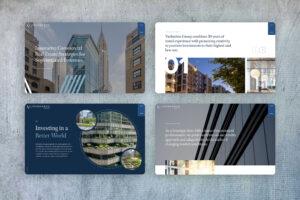
When we redesigned the digital presence for Vanbarton Group, a commercial real estate investment and advisory firm and the portfolio architecture was the starting point. Every other design decision followed from getting that right.

Perform Well on Desktop Without Ignoring Mobile.
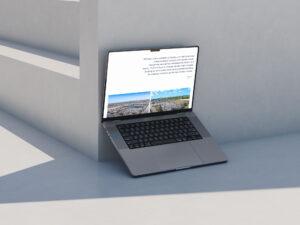
Consumer websites are often built mobile-first because most consumer traffic comes from phones. Commercial real estate is different. Your primary audience like investors, institutional partners, corporate tenants, and senior brokers are largely browsing on desktop, in an office, during the workday.
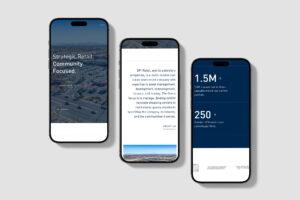
That does not mean ignoring mobile. Property owners and smaller tenants are more likely to be on their phones. And increasingly, research that starts on desktop continues on mobile. Your site needs to hold up on both.
But if you are making design tradeoffs, prioritize the desktop experience for the audiences that matter most to your revenue. A site that is beautiful on mobile but cramped and awkward on a large monitor is making the wrong tradeoff for a CRE firm.
Performance matters on every device. A slow site signals carelessness. For a firm asking investors to trust them with capital, that first-load experience carries more weight than most realize.
Make It Easy to Take the Next Step.
Every page on a commercial real estate website should answer one question: what does this person do next?
For an investor, that might mean requesting a deal deck or scheduling an introductory call. For a tenant, it might mean contacting a leasing team or requesting availability information. For a property owner, it might mean submitting a listing inquiry. For everyone, it means finding the right person to talk to without having to dig.
A common failure mode on CRE websites is the dead end. The visitor reads through a page, finds it compelling, and then the page just… stops. No clear next step. No relevant call to action. The visitor leaves without converting because the site did not tell them what to do.
Every page needs a clear, specific next step that matches the intent of the person who landed on it. This is not complicated. It just requires thinking about what action you want each visitor to take before you design the page.

Scale With the Firm’s Growth.
A CRE website should not require a rebuild every time the firm closes a significant transaction, enters a new market, or adds a practice area. The architecture should support growth – new deal pages, updated team profiles, market reports, and thought leadership content, all without breaking consistency.
That means building on a CMS that your team can actually manage. The ability to add a transaction, update a bio, or publish a market insight without engaging a developer every time is worth paying for in the initial build. It is the difference between a website that reflects your current business and one that perpetually lags behind it.
We build on WordPress for most of our real estate clients because it gives teams full ownership of their content long after launch. See our real estate web design approach

Your Website Should Work as Hard as Your Team Does.
A commercial real estate firm’s website is not a brochure. It is a business development tool. The firms that treat it that way by investing in the architecture, the content, and the ongoing maintenance are the ones whose websites are generating inquiries while their competitors’ sites just sit there.
If your site is not doing that work, it is worth understanding why. Sometimes it is a design problem. More often it is a strategy problem that showed up in the design.
We are happy to take a look and give you a straight read on what needs to change.
Talk with Terrain about your real estate website