How to Choose a Web Design Agency for Your Real Estate Business
Choosing a web design agency is one of those decisions that looks straightforward until it is not. There are thousands of agencies. Everyone has a portfolio. Everyone says the right things on their website. And the gap between what an agency promises in a proposal and what they actually deliver is one of the most reliable sources of frustration in business.
In real estate specifically, the stakes are higher than most industries. Your website is speaking to investors, institutional partners, buyers, and tenants – audiences with high expectations and short attention spans. A site that misses the mark does not just fail to impress. It actively works against you.
Here is what to look for when choosing a web design agency for your real estate business, and what to be skeptical of.
Look for Real Estate Experience, Not Just Design Experience.
A talented generalist agency can produce beautiful work. But beautiful work that does not understand your business or your audience is expensive decoration.
Real estate has specific requirements that generalists frequently get wrong. The audience is professional and skeptical. The content hierarchy is complex — you are serving investors, tenants, buyers, and partners simultaneously. The portfolio presentation requires context, not just photography. The credibility signals that matter in this industry are different from the ones that matter in consumer brands or tech.
When you look at an agency’s portfolio, look specifically for real estate work — commercial firms, developers, homebuilders, investment companies. Not just one project. A pattern of real estate work. That pattern tells you the agency has developed intuition about what works for this audience and what does not.
Terrain has worked with Stream Realty, Vanbarton Group, DPI Retail, and David Weekley Homes.
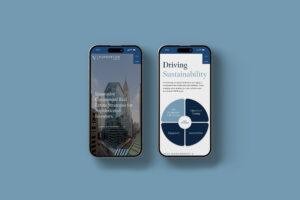
See how we approached Vanbarton Group – The experience compounds across projects in ways that matter when you are building something that needs to perform in this market.
Ask to See Case Studies, Not Just Examples.
Pretty layouts tell you what an agency can design. Case studies tell you whether the agency can solve problems.
The distinction matters because every real estate web project has a specific business challenge behind it. An investment firm needs to attract a certain caliber of institutional partner. A developer needs to pre-sell units before construction begins. A brokerage needs to communicate market expertise to corporate tenants who have options.
A good agency should be able to tell you what the challenge was, what decisions they made to address it, and what the outcome was. If their case studies are just portfolio images with a project name and a list of services, that is a sign the agency thinks about its work as visual output rather than business results.
Ask directly: what was the problem this client brought to you, and how did the design address it. The quality of that answer will tell you more than the portfolio images will.
See what makes a great real estate website.
Understand Who Is Actually Doing the Work.
The agency sales process and the agency delivery process are frequently run by different people. The principal or creative director who presents in the pitch meeting is often not the person who will be designing your website. That work goes to a more junior team member, or in some cases gets outsourced entirely to a contractor in another country.
This is not universal. But it is common enough to ask about directly.
Ask: who specifically will be working on my project. Will I have a single point of contact or will I be managed by an account manager. What is your team structure and how many projects are typically running simultaneously.
At Terrain, every project is led directly by our Founder and Creative Director. There is no account manager between the client and the person doing the creative work. For real estate clients who need someone who understands their business and their audience, that direct relationship is worth paying for. See our real estate web design process.
Evaluate Their Strategic Thinking, Not Just Their Aesthetics.
Design is how strategy becomes visible. If an agency cannot articulate the strategic thinking behind their work: why certain decisions were made, how the design serves the business goal – you are hiring decorators, not designers.
In a first meeting or proposal review, push on this. Ask why they made specific choices on a project you can see in their portfolio. Ask how they approach the discovery phase before design begins. Ask what questions they would want to answer about your business before they start designing.
An agency with genuine strategic depth will engage these questions with specific, considered answers. An agency that is primarily execution-focused will redirect back to the portfolio and the timeline.
For real estate specifically, the strategy questions that matter most are about audience architecture – who the site is serving and how the design serves each audience differently. If the agency does not bring this up before you do, that is a signal.
Check out the 5 must have features in a real estate website.
Be Skeptical of the Low Bid.
Real estate professionals understand that cheap deals are rarely good deals. The same logic applies to web design.
A website that costs significantly less than comparable work usually costs less for a reason. Offshore development. Junior designers. Template-based work dressed up as custom. Skipped strategy phases. These are not hypothetical risks, they are common outcomes of low-bid agency selection.
The cost of a cheap website is not just the initial investment. It is the rebuild cost when the site underperforms, the time spent managing a difficult agency relationship, and the deals that do not happen because the site failed to build the credibility it needed to.
For a real estate firm where a single closed deal can be worth six or seven figures, the difference between a $8,000 website and a $20,000 website is not meaningful. The difference between a website that builds investor confidence and one that does not is.
Make Sure You Will Own and Be Able to Maintain the Site.
This is the detail most real estate firms do not think about until it is a problem.
Some agencies build websites on proprietary platforms or in ways that create ongoing dependency on the agency for even basic updates. If you want to change a team bio, add a completed transaction, or update a property listing, you have to go through the agency and pay for the time. This model benefits the agency significantly and the client not at all.
Before you sign anything, ask: will I own the domain, the hosting, and all the code. Can my team make basic content updates without agency involvement. What platform is the site built on and what does ongoing maintenance look like.
The answer should be yes to all of the ownership questions. WordPress, built correctly, gives you full control. Your team can add transactions, update the team page, and publish market insights without touching code and without calling anyone.
If an agency is vague about your ownership rights or suggests that ongoing dependency is just how the industry works, that is a dealbreaker.
The Right Agency Is a Partner, Not a Vendor.
The best web design relationships in real estate look less like a transaction and more like a partnership. The agency understands your market, your audience, and your business goals well enough to push back when a design decision is working against those goals. You trust their judgment enough to let them.
That level of relationship requires finding an agency that has done serious real estate work, thinks strategically, and is honest with you about what your site needs rather than what is easiest to sell.
If you are in the process of evaluating agencies and want a second opinion on your current site or what a new one would require, we are happy to have that conversation.